
AGENDA
Earn up to 12 CPE Credits!
The agenda was created to combine flexibility and maximum impact while also providing unique networking environments.
Schedule and topics are subject to change
Conference Schedule
Sunday, September 27
-
Registration and Welcome Reception with Sponsors
6:00pm - 8:00pm
Get a head start on registration, catching up with friends, and meeting with the sponsors.
Monday, September 28
-
Registration & Breakfast
7:00 am - 8:15 am
-
Chapter Summit
7:30 am - 9:30 am
Representative Heidi Boe, VP from CFMA National attending
By invitation only
Concurrent Sessions
-
GC & Sub Couples Therapy: Let's Talk About Finances
8:15 am - 9:30 am
Presented by: Claire Wilson, Siteline
Session Overview:
Construction is one of the slowest-paying industries globally. The billing process is notoriously stressful and can strain the relationship between subcontractors and general contractors. In this session, Claire Wilson will facilitate an open discussion between GCs and subs on how we can work together to improve the billing process, resolve change-order issues, and get paid faster.
Learning Objectives:
Identify the main causes of payment delays and actionable solutions to address them.
Recognize billing red flags and learn how to address them before they escalate.
Understand both GCs’ and subcontractors’ perspectives to foster better communication and collaboration.
Gain concrete strategies to improve billing processes and strengthen relationships, both internally and with clients.
Level: Basic
1.5 CPE Credits in Business Management & Organization
-
Equipment Costing Methods & KPIs
8:15 am - 9:30 am
Presented by: Yvette Aubin, EBSARY Foundation Company
Session Overview:
We will cover three critical topics to manage your company’s equipment fleet whether large or small:
Costing methods to effectively allocate your equipment costs to projects
Key Performance Indicators
How to use those KPIs to Benchmark your fleet and identify trends.
Establishing effective and appropriate methods for charging equipment costs to jobs is critical in accounting for contract costs. We will review different strategies and methods for equipment costing and allocation. We will explore best practices in aligning your estimating, budgeting, and accounting methods for equipment costs. CFMA and AEMP (Association of Equipment Maintenance Professionals) have partnered to develop the Heavy Equipment Comparator (HEC). The HEC is a valuable tool that tracks 29 KPIs in nine different categories to follow a company’s fleet results. It can be used to benchmark your company’s results against other companies in the Heavy Construction space and identify areas to improve your fleet management.
Learning Objectives:
Identify appropriate cost methods and options to allocate equipment costs to jobs and repairs.
Recognize the economics of equipment costing and alignment throughout the project life cycle.
Understand how to utilize the Key Performance Indicators & the Heavy Equipment Comparator to evaluate, benchmark, and improve your fleet’s performance.
Gain insights on how to use KPIs to benchmark your fleet.
Level: Intermediate
1.5 CPE Credits in Specialized Knowledge
-
Break with Refreshments (30 min)
9:30 am - 10:00 am
Concurrent Sessions
-
Bill Baby Bill! Cash Flow Strategies for Contractors
10:00 am - 10:50 am
Presented by: Bill Hughes, Wipfli Advisory LLC
Session Overview:
Strong cash flow is the lifeblood of every construction company, yet many contractors struggle despite profitable projects on paper. In this interactive session, Bill Hughes, uses humor, real-world examples, and role-playing to walk through the full project lifecycle — from preconstruction and contract negotiation through billing, collections, and retainage release. Bill draws on decades of experience as a contractor CFO, consultant, and construction CPA to share proven strategies that improve billing accuracy, accelerate collections, and avoid the common pitfalls that silently drain working capital. The session emphasizes shared accountability across project managers, operations, and finance, because cash flow is everyone's job. Attendees will leave with actionable tools to build a more predictable, profitable cash flow process and stronger financial performance for the long haul.
Learning Objectives:
Identify the key phases of the construction cash flow lifecycle and explain how decisions at each stage, from preconstruction through collections and retainage release and impact liquidity and risk.
Apply best practices for billing accuracy, customer prequalification, schedule of values design, and collections follow-up to reduce underbilling, late payments, and margin erosion.
Recognize warning signs of cash flow distress and develop practical strategies, including team accountability and technology-enabled tracking to support long-term financial health.
Review ancillary activities and structures to ensure the business is positioned for sustainable, long-term cash flow health and financial resilience.
Level: Intermediate
1.0 CPE Credits in Accounting
-
Building Bridges: Not Barriers: Culture, Language and Mental Wellness
10:00 am - 10:50 am
Presented by: Brad Anderson, IMA & Panel
Panelists:
Dorsey Standish, Mastermind
Eli Embleton, Zachry Construction
Matt Hollensworth, Austin Industries
Session Overview: Physical safety has long been a priority in construction. Still, many organizations are now confronting different challenges: the human and financial costs of loneliness, burnout, disconnection, and declining mental well-being. This session brings together industry leaders, lived experience, behavioral science, and practical construction insights to explore how connection influences safety, retention, engagement, and workforce resilience while providing actionable strategies that leaders can apply immediately. Attendees will leave with a deeper understanding of why connection is not simply a personal issue, but a strategic business imperative that impacts both people and performance.
Learning Objectives:
Identify the human and financial costs of disconnection in the construction workforce, including impacts on safety, retention, engagement, and overall organizational performance.
Describe how construction data, field experience, culture, and brain science help explain the relationship among loneliness, stress, burnout, and team cohesion.
Apply practical strategies that strengthen connections, improve communication, support mental wellness, and build more resilient construction teams.
Level: Intermediate
1.0 CPE Credits in Personal Development
-
Short Break (10 min)
10:50 am - 11:00 am
Concurrent Sessions
-
CIE: Risks, Red Flags, & Remedies
11:00 am - 11:50 am
Presented by: Robin Thomas, The Beck Group
Session Overview:
Costs in Excess of Billings are common in construction but are often misunderstood. In this session, we’ll explore what causes these imbalances, how they impact cash flow and profitability, and the red flags that every project team should recognize. Attendees will walk away with real-world strategies for managing costs in excess across accounting, project management, and financial reporting.
Learning Obectives:
Analyze project-level scenarios to identify common root causes of costs in excess, including scheduling mismatches, change order delays, and billing cycle gaps.
Interpret the impact of costs in excess on work-in-progress (WIP) reports and explain its implications for financial reporting, bonding capacity, and audit readiness.
Develop communication strategies that bridge gaps between project management and accounting teams, fostering early detection and resolution of billing discrepancies.
Implement preventative controls and tracking mechanisms using construction-specific tools like ERPs, or similar platforms to monitor costs in real time.
Level: Basic
1.0 CPE Credits in Accounting
-
Ownership Transition: ESOPs and Bank Financing
11:00 am - 11:50 am
Presented by: Chris VanTassel, Wintrust Commercial Banking
Pat Stoltz, Wintrust Commercial Banking
Matt Doucet, Wintrust Commercial Banking
Session Overview:
Employee Stock Ownership Plans (ESOPs) have become an increasingly attractive ownership transition strategy for construction companies. This session will provide an overview of how ESOPs work, the advantages and challenges of the structure, and the key advisors involved throughout the process. We’ll discuss current trends in the construction industry, considerations for CFOs evaluating an ESOP, financing strategies and lender expectations, and the ongoing governance and compliance requirements after the transaction, including annual valuations and other fiduciary responsibilities.
Learning Obectives:
Better understanding of how ESOPs work
Pros and Cons of ESOPs
Understanding the financing of ESOPs
Ongoing Due Diligence/Compliance of ESOPs
Level: Intermediate
1.0 CPE Credits in Business Management & Organization
-
Lunch
11:50 pm - 12:45 pm
-
Welcome Remarks and National CFMA Greeting
12:45 pm - 1:15 pm
Presented by: Anna Fisher, Lone Star Conference Chair | Bryce McDermott, CFMA Vice Chair |
Heidi Boe, CFMA VP, Member Engagement
-
KEYNOTE: There Is No Mystery to it: Success in Acting Is Like Success in Any Other Business
1:15 pm - 2:05 pm
Presented by: Andy Buckley
Session Overview:
After spending 10 years as a Wealth Manager at Merrill Lynch and later becoming known to audiences as David Wallace on NBC'sThe Office, Andy Buckley discovered that success in Hollywood is built on many of the same principles that drive success in business. Drawing on experiences from both industries, Andy shares practical lessons on preparation, consistency, communication, teamwork, and commitment to excellence. Through engaging stories and real-world examples, attendees will gain insights they can apply to strengthen professional relationships, improve performance, and achieve long-term success. Success is often perceived as the result of talent, luck, or special circumstances. Drawing from his unique career path in both finance and entertainment, Andy Buckley demonstrates that lasting success is built on universal principles that apply regardless of profession. Through personal stories, humor, and practical insights, attendees will explore how preparation, excellence, communication, and collaboration can help individuals and teams reach their full potential.
Learning Objectives:
Identify key habits and behaviors that contribute to sustained professional success across industries.
Recognize the role preparation and consistency play in achieving individual and organizational goals.
Describe how open and transparent communication helps build trust and strengthen professional relationships.
Explain the importance of teamwork and collaboration in achieving high levels of performance.
Apply lessons from the entertainment and financial services industries to their own professional development.
Level: Basic
1.0 CPE Credits in Personal Development
-
Meet & Greet with Andy Buckley
2:05 pm - 2:40 pm
Feel free to bring your own "The Office" memorabilia for Andy to sign.
-
Cybersecurity Risk and Trends for 2026
2:40 pm - 3:30 pm
Presented by: David Anderson, CLA Connect
Session Overview:
This presentation explores cybersecurity trends and common vulnerabilities organizations face in today’s digital landscape. Drawing on real-world observations, it highlights common weaknesses such as default vendor credentials, unpatched systems, insecure user permissions, and inadequate network segmentation. We will also touch on emerging trends, such AI/deepfake attacks designed to trick employees. Attendees will gain insights into why these risks persist, their potential impact on business operations, and strategies to mitigate them. The session is designed to help IT and risk management leaders strengthen their defenses and reduce exposure to evolving threats.
Learning Obectives:
Understand the latest trends in cybersecurity risk
Review common approaches used to identify risk in your organization
Explore ways to mitigate risk – both across your business processes and your IT environment
Level: Overview
1.0 CPE Credits in Information Technology
-
Short Break (10 min)
3:30 pm - 3:40 pm
-
Financial Fluency as a Strategic Advantage: What Construction Leaders Must Know Next
3:40 pm - 4:30 pm
Presented by: Caryl Coronis, CFMA Chair 2024-25 & CFMA Panel
Moderator: Caryl Coronis
Panelists:
Tyler Stein, Frost Bank
Samantha Hutchison, Brookstone Construction
Jerry Fuentes, CPA, Baker Tilly
David Wightman, Alliant Insurance Services
Session Overview:
In today’s construction landscape—marked by tighter margins, complex delivery models, increased risk, and heightened scrutiny- financial fluency has become essential for leaders across the organization, not just those in finance. This CFMA-led thought‑leadership panel will explore how strong construction financial knowledge directly shapes project performance, enterprise risk management, and long‑term organizational resilience. Through candid discussion and real‑world examples, panelists will examine how financial insight drives better decision‑making throughout the entire project lifecycle—from pursuit strategy and contract structure to cash flow management, controls, and capital planning. Panelists will include a combination of leaders such as a CFO, Controller and experts representing surety or banking. The conversation will also challenge traditional operational silos. It will highlight why construction managers and owners must understand the financial forces influencing contractor behavior—and why organizations that elevate construction finance expertise through highly skilled teams and credentialed professionals are better equipped to deliver certainty, transparency, and value. A key focus will be on the role of trusted business partners and financial leaders who bring specialized construction finance knowledge, including those who hold the Certified Construction Industry Financial Professional (CCIFP) designation. Panelists will discuss how credentialed professionals enhance collaboration, strengthen risk awareness, and support more informed leadership conversations that benefit owners, contractors, and project teams alike. This session is designed for construction executives, owners, and managers who want to lead with greater clarity, confidence, and financial intelligence—and who recognize that the future of construction success depends on aligning operational excellence with financial mastery.
Learning Objectives:
Explain why financial literacy has become a critical leadership competency in today's construction industry.
Describe how construction-specific financial expertise supports better decision-making, risk management, and business performance.
Evaluate the value that specialized, credentialed financial professionals bring to construction organizations.
Identify the key capabilities and strategic guidance construction leaders should expect from their financial partners in an increasingly complex and evolving industry.
Level: Overview
1.0 CPE Credits in Finance
-
Short Break (10 min)
4:30 pm - 4:40 pm
Concurrent Sessions
-
AI in Construction: Unlocking Financial and Operational Value
4:40 pm - 5:30 pm
Presented by: Jordan Anderson, Baker Tilly
Session Overview:
AI is reshaping the construction industry, delivering measurable financial impact through enhanced forecasting, real-time cost control, and stronger risk management. For finance leaders, the opportunity lies in automating routine processes, accelerating estimating, analyzing change orders with greater precision, and strengthening compliance. This session will explore practical AI applications that reduce overruns, streamline reporting, and optimize operations, empowering finance professionals to drive profitability and strategic advantage.
Learning Objectives:
Understand AI’s Financial Impact – Learn how AI enhances forecasting accuracy, cost controls, and risk management in construction projects.
Identify High-Value Use Cases – Explore where AI delivers measurable ROI, from automated estimating to compliance monitoring and fraud detection.
Apply AI Strategically – Gain insights on governance, adoption strategies, and how finance professionals can drive profitability with AI.
Level: Basic
1.0 CPE Credits in Information Technology
-
Employee Experience: The Key to Retention & ROI
4:40 pm - 5:30 pm
Presented by: John Laufer, Miter
Session Overview:
Construction firms are facing unprecedented labor pressure as demand accelerates and experienced workers exit the industry. This session reframes “employee experience” from an abstract idea into a practical, measurable driver of talent density, retention, and financial performance. Attendees will learn how everyday systems, safety, and growth opportunities shape outcomes, and how a few well-timed improvements can reduce turnover and deliver real ROI.
Learning Objectives:
Define talent density and connect it to operational and financial performance.
Identify the employee experience levers that most influence retention in construction teams.
Estimate the true cost of turnover using a simple “turnover tax” model.
Level: Intermediate
1.0 CPE Credits in Business Management & Organization
-
Monday Night Event:
6:00 pm - 9:00 pm
Cap City Comedy ClubWe have a fun evening planned at Cap City Comedy Club, with plenty of time to unwind and catch up with friends, enjoy great food and drinks, and take in some clean entertainment!
Tuesday, September 29
-
Registration & Breakfast
7:00am - 8:00am
Concurrent Sessions
-
Negotiating Insurance and Construction Provisions in a Construction Contract
8:00 am - 8:50 am
Presented by: Christian Dewhurst & Brian Waters, Gray Reed
Session Overview:
This session is designed for construction financial professionals looking to better evaluate contract risk, negotiate effectively, and safeguard project profitability in an uncertain market. This session provides a practical framework for structuring insurance and construction provisions that protect margins and reduce dispute exposure. Attendees will gain insight into key areas including indemnity and additional insured provisions, common coverage gaps, and the enforceability of risk transfer obligations.
The program also addresses how to manage economic and geopolitical pressures—such as tariffs, inflation, and supply chain disruptions tied to global trade routes like the Strait of Hormuz—through effective contract drafting. Participants will walk away with actionable strategies, including:
Learning Objectives:
Structuring escalation and price adjustment clauses
Allocating tariff-related cost risk
Using force majeure and change-in-law provisions effectively
Preserving claims and legal remedies through proper documentation
Level: Intermediate
1.0 CPE Credits in Business Law
-
Taking Control of Your Health Plan: Evaluating Alternative Health Plan Strategies
8:00 am - 8:50 am
Presented by: Luke Davis, Novaura
Session Overview:
The rising costs of healthcare are unsustainable, but employers hold more leverage than they've been led to believe. Strategic financial and HR leaders who are controlling their healthcare costs are looking beyond the traditional quoting spreadsheet. This session exposes the reality of the healthcare industry and reveals how leaders can identify true cost drivers, eliminate misaligned incentives, and demand transparency in their health plan. In this session, you will discover:
The Executive Playbook: How forward-thinking companies are simultaneously lowering healthcare claims, improving patient outcomes, and enhancing employee benefits.
Funding Mechanisms: How to analyze and choose the right structure for your organization.
Rx Cost Control: Innovative strategies to combat the skyrocketing cost of prescription drugs.
Learning Objectives:
Identifying the major cost drivers of health insurance
Understand the different strategies employers can use to fund their health plan.
Learn about how innovative cost-containment methods are used to lower health care costs (Specialty-Rx carveouts, Direct contracts, RBP, etc.)
Level: Overview
1.0 CPE Credits in Business Management & Organization
-
Short Break (10 min)
8:50 am - 9:00 am
Concurrent Sessions
-
When Technology Outpaces Your Risk Program: Governing AI, Data, and Emerging Technology in Construction
9:00 am - 9:50 am
Presented by: Lee Carsten, Whitecap Risk Advisors
Session Overview:
Construction financial leaders have built some of the strongest risk management programs in any industry. Safety governance, bonding discipline, insurance strategy, contract risk. They manage these things well because they own them, measure them, and report on them like any other business metric. The technology those same firms adopted to run their businesses more efficiently has quietly created a new category of risk that most risk programs have not kept pace with. AI is embedded in project management software, accounting platforms, and field tools. Employees are using their own tools independently, feeding project specs, contract language, and financial data into systems nobody in leadership approved. And now insurers are asking about technology governance at renewal. Clients and GCs are building technology requirements into vendor qualifications. Bonding companies are paying closer attention to digital risk profiles. This session uses framework construction financial professionals already understand: the safety governance arc. The same pressure points that drove safety investment (incidents, regulation, insurance consequences, client requirements) are now showing up in technology risk, all at once. When a technology incident happens, it lands on the desk of the people already managing bonding, insurance, contract risk, and cash flow. This session is built around that reality. Attendees will leave with a practical governance framework sized for construction firms, three questions that create immediate accountability in their own organizations, and a clear picture of the financial exposure they are likely already carrying.
Learning Objectives:
Identify the technology risk categories creating measurable financial exposure for construction firms right now and describe how each shows up in financial and operational terms, including shadow AI, uncontrolled data, invisible vendor access, supply chain exposure, and regulatory and insurance compliance gaps.
Apply a safety governance framework to technology risk management by defining ownership, metrics, reporting, and accountability structures that fit the size and resources of a construction firm.
Evaluate their firm's current technology risk posture using three diagnostic questions designed for financial leaders, and identify the first steps toward a governance program that can satisfy insurer, bonding, and client requirements.
Level: Intermediate
1.0 CPE Credits in Information Technology
-
Beyond Bar Charts: Choosing the Right Visualization for Your Dashboard Reports
9:00 am - 9:50 am
Presented by: Ken Jones, Business Information Group
Session Overview:
Effective data storytelling hinges on selecting visuals that match your message. This session explores dashboard visualizations, their strengths, and ideal use cases. Learn to match chart types to data and goals, go beyond basic charts for impactful visuals, and design compelling reports. Beneficial for those wanting to elevate dashboard reports through effective data visualization. Unlock insights by visualizing data powerfully.
Learning Objectives:
Explain how visualization choices impact decision-making in construction dashboards
Understand how different chart types of influence interpretation can either clarify or distort insights.
Distinguish between data dumping and effective data storytelling
Identify how to structure dashboards around decisions and key messages rather than raw data volume. Select appropriate dashboard visuals based on audience and business intent
Match visual design to the needs of project managers, controllers, and executives. Evaluate common dashboard visualizations and identify when advanced visuals add value
Recognize the strengths and limitations of traditional charts and when alternative visuals better communicate variance, trends, or drivers.
Level: Basic
1.0 CPE credits in Specialized Knowledge
-
Break with Refreshments (30 min)
9:50 am - 10:20 am
Concurrent Sessions
-
Profit Mastery: What is YOUR Magic Number?
10:20 am - 11:35 am
Presented by: Carrie Bradshaw, CD Bradshaw
Session Overview:
Most business owners have profit goals, but profit is driven by one powerful number. In this high-impact session, we uncover the “magic number” that reveals exactly how much a business must make to cover fixed costs and turn every additional dollar into real profit. Using plain English, compelling visuals, and real-world stories, break-even analysis is transformed from an accounting concept into a practical roadmap for smarter pricing, confident hiring, and faster, more strategic responses to rising costs and competitive pressure. This isn’t financial theory or spreadsheet overload; it’s an eye-opening, actionable experience that replaces guesswork with clarity and empowers business owners to build profit intentionally, not accidentally.
Learning Objectives:
Understand the concept of break-even analysis and why it matters in business decision-making
Identify the key components that drive profitability, including fixed costs, variable costs, and margin
Calculate and interpret the “magic number” needed to cover costs and generate profit
Level: Basic to Intermediate
1.5 CPE Credits in Finance
-
3 Reasons Why Some Contractors are Wildly Successful (and most will never be)
10:20 am - 11:35 am
Presented by: Eliot Wagonheim, First Rule Contract Manager
Session Overview:
After having worked and interacted with hundreds of contractors throughout the United States, I’ve learned that, as diverse as these companies may be in terms of trade, size, geographic areas and specialties, there are a few stark, bold lines that separate incredibly successful contractors from the vast majority that perennially chase the kind of success they covet. In this engaging session, Eliot Wagonheim presents those mission-critical features of highly successful companies…and what every company should hardwire into their DNA to guide them in selecting projects, identifying contract deal-breakers, and resolving issues before they become company-killing problems.
Learning Objectives:
Formulate an effective go/no-go mindset which they can apply to every opportunity.
Develop a contract decision-making framework to evaluate risk and opportunities.
Understand the simple structure of impactful communications that protect their interests while building relationships.
Level: Intermediate
1.5 CPE Credits in Business Law
-
Lunch
11:35am - 12:30 pm
-
What do today’s economic signals mean for construction businesses planning for the year ahead?
12:30 pm - 1:20 pm
Presented by: Dr. Jon Murphy, AM Advisors
Session Overview:
What do today’s economic signals mean for construction businesses planning for the year ahead? Dr. Jon Murphy will translate complex economic trends into practical insights for construction financial professionals. The session will examine the forces shaping construction demand, interest rates, inflation, labor availability, material costs, and business investment. Attendees will learn which indicators deserve attention, how changing economic conditions can affect backlogs and margins, and how to use economic insight to strengthen forecasting, budgeting, and strategic decision-making in an uncertain market.
Learning Objectives:
What are the major factors influencing interest rates in the coming period
How tariffs will influence costs for firms
What macroeconomic factors present risks or opportunities
Factors influencing labor costs
Level: Overview
1.0 CPE Credits in Economics
-
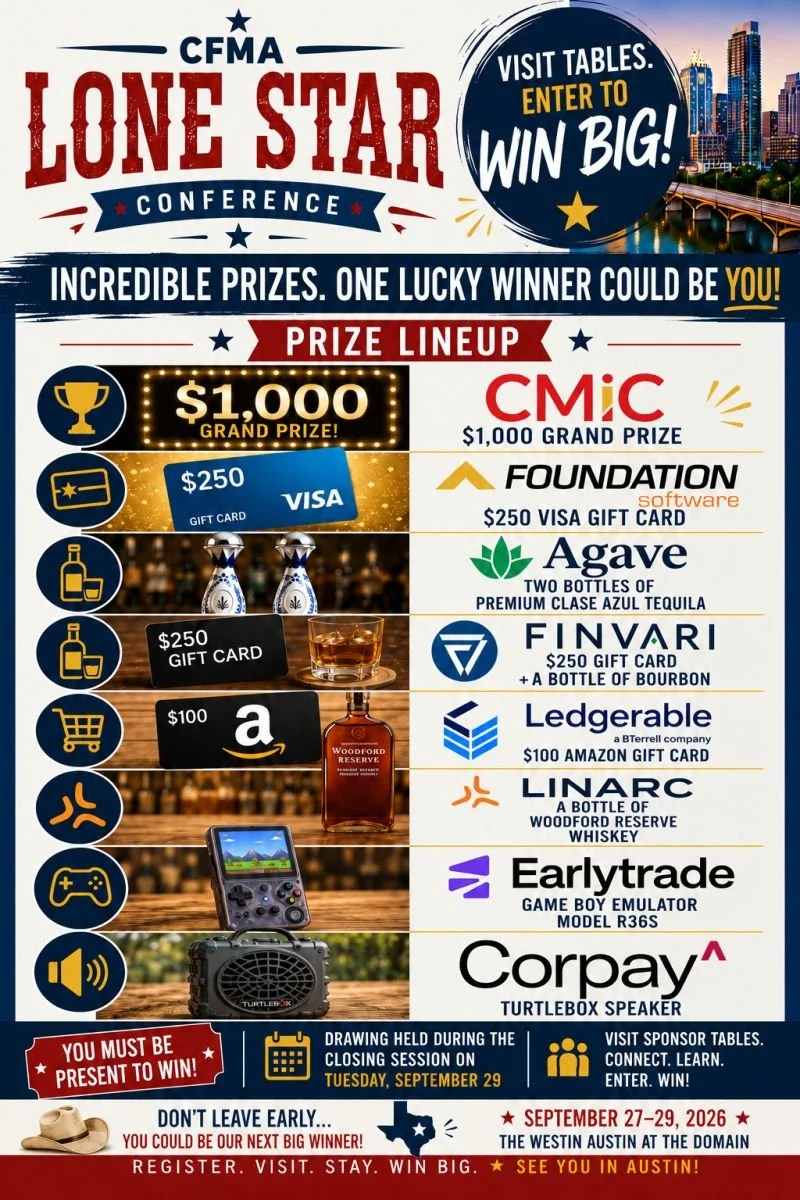
Closing & Raffle
1:20pm - 2:30pm
Recipients of the CFMA Lone Star prizes must be present to win.
Sponsor prize rules may vary.

The Construction Financial Management Association (CFMA) is registered with the National Association of State Boards of Accountancy (NASBA) as a sponsor of continuing professional education on the National Registry of CPE Sponsors. State boards of accountancy have final authority on the acceptance of individual courses for CPE credit. Complaints regarding registered sponsors may be addressed to the National Registry of CPE Sponsors through its website: https://www.nasbaregistry.org.